A free mystery hunt for your library's children's area
Tape up six signs. Kids follow a riddle trail, solve a little math at their own level, and bring a code to your desk. It's a screen-free program: kids play on paper. Everything on this page is free for libraries. The kit needs no sign-up and no patron data, and it prints in black and white.
New: free for your children's area
Library Mystery Hunt
For ages 4 to 10: six clue signs with a riddle trail that loops, so kids can start anywhere. Three math levels with the same answer, a detective notebook, a code the desk checks, and a take-home treasure hunt for families. Download the PDF and tape it up. Prints in black and white. No sign-up.
Get the free kitHow is this free? Some families who print a hunt at home later buy more hunts for their own house. That pays for HideQuest. Your library pays nothing for any of this, and no patron data comes to us.
Welcome to HideQuest
What's here for your library, what's free, and how HideQuest is paid for.
Read the steps
- Welcome, librarians. HideQuest offers free, screen-free learning through adventure: for families, classrooms and homeschoolers, and for your library, a free mystery hunt.
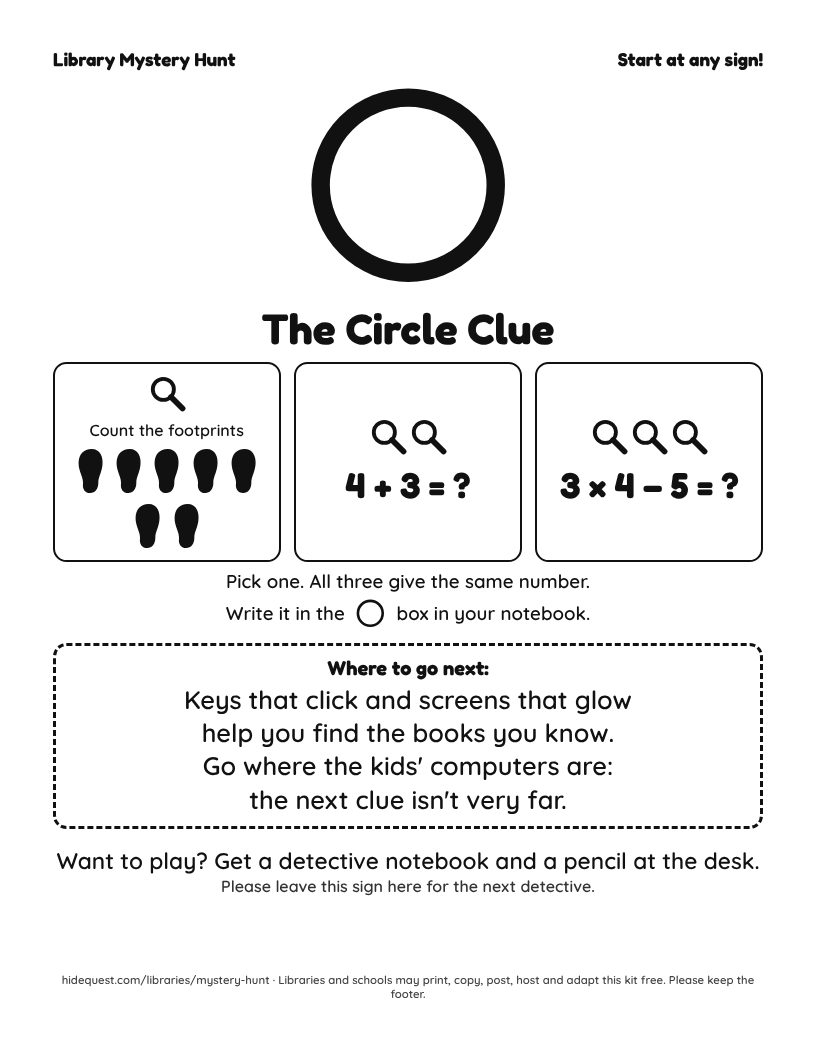
- Tape up six clue signs. Each sign has three levels, and all three give the same number.
- Kids fill in their notebook and bring the code to your desk.
- Posters and bookmarks send families home with a free hunt. With a free staff account, you can make hunts for your own shelves.
- It's all free, with no patron data.
- Families who buy hunts for home pay for HideQuest.
- Get the free kit on this page.
How to set it up
For staff: where the six signs go, and what stays at the desk.
- Step one: tape up the six clue signs. The kit uses spots most libraries have.
- Missing one, or want a different spot? Swap it in. Each riddle leads to the next sign, so kids can start anywhere.
- Step two: at your desk, set out the Start Here sign, notebooks, pencils, and the final riddles. Keep the desk strip with the code on your side.
- Step three: pick a spot for the Secret Shelf. Set out the take-home hunts there, and anything else you like.
- When a kid brings six numbers, check them against the strip. A match gets the final riddle.
- Walk the loop once before you open.
How kids play
What a detective does, from the desk to the Secret Shelf.
- Go to the desk for a detective notebook and a pencil.
- Pick your level: count, add and take away, or times tables.
- Find any shape sign. Solve it, and write the number in the box with the same shape.
- Read the riddle. It tells you where the next sign is hiding.
- Keep going, sign to sign, until all six boxes are full.
- Bring your code back to the desk. If it matches, you get the final riddle.
- It leads to the Secret Shelf, where your next case is waiting: a treasure hunt to take home. Your notebook is yours to keep.
Also free for libraries: HideQuest's treasure hunts, rhyming clue cards that lead kids from one hiding spot to the next. Families can print one at home, or you can make one for your own building.
For families: a free hunt to take home
Each season there is a free hunt families can print at home, with no signup. Print a poster for the children's area and a stack of bookmarks for checkout: each has a riddle kids can solve on the spot, and families scan the code with a phone and print the hunt when they get home.
For your building: a hunt for your children's area
Make a hunt with your own hiding spots, like the picture-book bins, the reading nook or the new-books display. Pick the ages, print the clue cards, and hide them before you open. It works as a passive program for a week or as a family event.
- Pick up to eight spots in the children's area that kids can reach without climbing, away from doors and stairs. Tape cards beside or under things rather than inside books, so the shelves stay tidy.
- Print the clue cards and code sheets. Hide each card where the clue before it points.
- Make the desk the last stop. Type the front desk as your final hiding spot and keep the prize there (a sticker, a bookmark, whatever you like). Kids show staff their finished code to collect it.
New to treasure hunts? Watch how one plays.
Free staff accounts
Library staff get a free HideQuest account for making hunts for your own shelves: your hiding spots, the ages you pick. Sign up with your library work email, and we'll email it a button to confirm.
No library email, or a question? Write to dan@hidequest.com. Dan, a dad in Franklin, Wisconsin, who makes HideQuest.
Staff accounts run through December 31, 2027.
Privacy
Families never sign up or give a name to print the free hunt. HideQuest never asks for library card numbers, and no patron data comes to us. The clue cards don't use children's names unless the grown-up making the hunt types them in.
If you keep a page of kids' or homeschool resources
You're welcome to list us if it fits. Optional, and nothing above depends on it. A line you can use:
HideQuest: free printable treasure hunts with rhyming clue cards and a little math at each child's level. https://hidequest.com/libraries